


 0

First semester jump in slaughter
Colombian swine slaughter in the first half of the year has not trended linearly over the last five years: it grew 3.0% in 2023, accelerated to 8.6% in 2024, moderated again to 2.9% in 2025, and jumped 15.0% in 2026, the largest year-on-year variation of the entire period analyzed. The cumulative total for the first half of 2026 reached 3,489,955 head, the highest six-month volume in the five-year series and equivalent to a compound annual growth rate (CAGR) of 7.3% between 2022 and 2026. Specifically for June, slaughter amounted to 615,961 head, 19.2% higher than the same month in 2025 and 0.9% higher than May. This result ranks as the second-highest monthly record in the entire 2022-2026 series, only below the historical maximum of December 2025 (702,414 head).

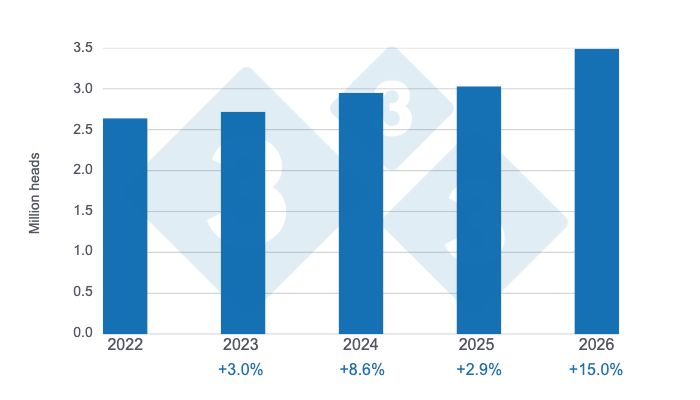
Evolution of swine slaughter in Colombia in the first half of the last 5 years, year-on-year variations. Prepared by 333 Latin America with data from ESAG - DANE.
General departmental growth
The growth in the first half of the year was not concentrated in a single department: the main sources of national slaughter grew simultaneously compared to the same period in 2025. Antioquia, which continues to be the largest producer with 40.8% of the national slaughter for the first half of the year (1,423,007 head), grew by 11.6%, the slowest pace among the leading departments. Meanwhile, Valle del Cauca (539,244 head) saw the most growth with an increase of 18.6%, closely followed by Risaralda (227,804 head, +17.7%) and Cundinamarca (549,681 head, +16.4%). Together, these four departments accounted for 78.5% of the national slaughter for the first half of the year, while the rest of the country, with a growth of 17.7%, contributed the remaining 21.5% (750,219 head). In that sense, the jump in national slaughter in 2026 did not respond to the dynamics of a single region, but to a generalized behavior throughout the country's pork production map.
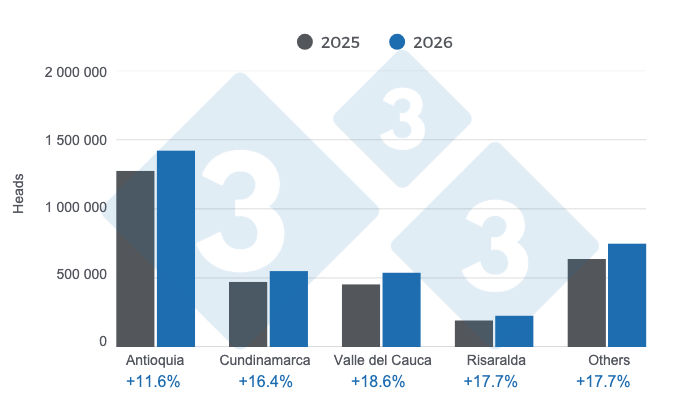
Swine slaughter in Colombia by department in the first half of 2026, year-on-year changes. Prepared by 333 Latin America with data from ESAG - DANE.
Weight and yield: A moderate contribution versus the slaughter rate
Unlike slaughter, average pig weights in Colombia advanced at a much more conservative pace between 2022 and 2026. The average live weight in the first half of the year went from 114.2 kg/animal in 2022 to 117.8 kg/animal in 2026, an increase of just 3.2% in five years (CAGR of 0.8%), while carcass weight moved from 93.2 kg to 95.9 kg in the same period, an advance of 2.9% (CAGR of 0.7%). Carcass yield, meanwhile, remained virtually stable throughout the period, between 81.4% and 81.7% across the five semesters analyzed, without a clear upward or downward trend. Specifically for June, the average live weight reached 118.65 kg/animal, the highest in the entire 2022-2026 series, while carcass weight stood at 96.79 kg, the second highest monthly figure, surpassed only by the 97.79 kg recorded in March 2025. June's carcass yield was estimated at 81.58%, a result close to the historical average for the month and higher than the 81.11% recorded in June 2025.
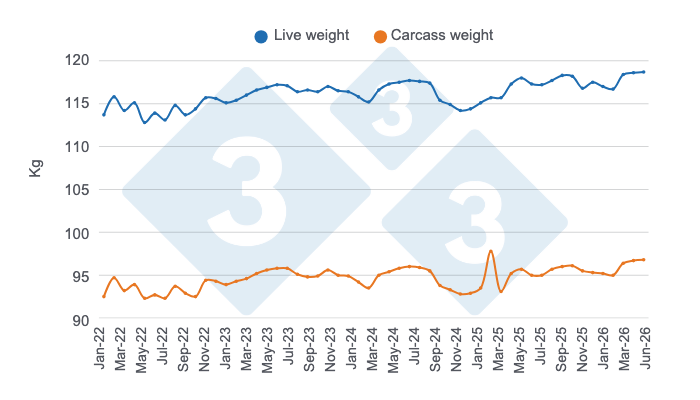
Monthly evolution of Colombia's average live and carcass weights for pigs over the last 4 years and the first half of 2026. Prepared by 333 Latin America with data from ESAG - DANE.
In conclusion
What we observed in the first half of 2026 is, above all, a generalized increase in pig slaughter across all of Colombia's leading regions. The country is slaughtering significantly more animals, but not necessarily heavier ones. Meanwhile, live weight in June marked a record high for the analyzed period, but carcass weight and yield remained within typical ranges, confirming that the jump observed in 2026 was due to the volume of animals slaughtered and not to a structural improvement in weights.
333 Latin America with data from the National Administrative Department of Statistics (DANE).
https://www.dane.gov.co/